Riprap & Living Shoreline in Panama City, FL
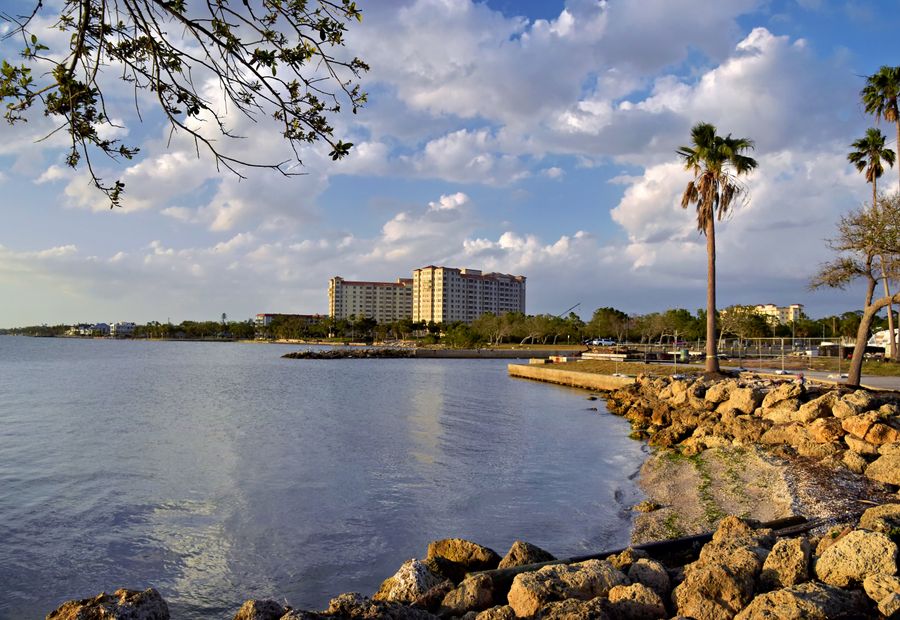
Not every eroding shoreline in Panama City needs a vertical seawall, and on much of St Andrews Bay a softer approach holds better and permits easier. Panama City Seawall builds riprap revetments and living shorelines as well as walls, and on the right bank we will tell you the softer approach is the better answer.
Riprap: Rock That Absorbs the Energy
A riprap revetment is a graded slope of heavy stone keyed into the bank over filter fabric. Where a vertical wall stands and reflects wave energy, and can scour its own toe, riprap absorbs and scatters that energy and drains freely, with no cap to spall and no anchors to fail. On a lower or sloping bay bank it is often the more durable, lower-maintenance answer, and on exposed banks it armors the toe against surge.
Living Shorelines on the Bay
A living shoreline stops erosion with a low rock sill, sand, and native marsh grass instead of a wall. The sill and the marsh absorb wave energy and hold the bank, and the marsh keeps growing and repairing itself. On the sheltered bayous and back-bay shorelines around Panama City it holds well and adds back the habitat that hardened shorelines took, and Florida increasingly favors it over new vertical walls where the site suits it.
Matching the Method to the Exposure
The treatment has to match the water. On the open Gulf and near the pass, the surge and wave energy call for a hardened wall or a heavy revetment. On the sheltered bay and bayous, riprap or a living shoreline holds well and permits easier. We read the fetch, the wake, and the surge, then recommend the approach that holds, whether a wall, rock, marsh, or a hybrid.
Built to the Florida Permit
Shoreline stabilization on the bay runs through the Florida Department of Environmental Protection, the Army Corps, and Bay County, and living shorelines have permit pathways the state has worked to streamline. We design to what is permittable and prepare the application for the work we build.
Watching your bay bank wash away? Call (850) 555-0173 and we will tell you whether your shoreline wants a wall, rock, marsh, or a mix.
What is riprap and when is it better than a seawall?
Riprap is a graded slope of heavy stone keyed into the bank over filter fabric. Instead of standing vertical and reflecting wave energy like a seawall, it absorbs and scatters the energy and drains freely, with no cap or anchors to fail. On a lower bank, a sloping bay shoreline, or a lot where a vertical wall would only scour its own toe, riprap is often the more durable and lower-maintenance answer, and Florida increasingly favors it and living shorelines over new vertical walls.
What is a living shoreline on the bay?
It is erosion control that uses graded stone, sand, and marsh or dune plants instead of a vertical wall. A low rock sill is built just offshore, sand is placed behind it, and native marsh grass is planted in the sand. The sill and the marsh absorb wave energy and hold the bank, and the marsh keeps growing and self-repairing. On the sheltered bayous and bay shorelines around Panama City it can hold a bank well and adds back the habitat that hardened shorelines lost.
Will a living shoreline hold on the Gulf side?
It depends on the exposure. On the open Gulf and near the pass, wave and surge energy is high, and a hardened wall or a heavy riprap revetment is usually needed. On the sheltered bay, the bayous, and the back shorelines, a living shoreline or a riprap sill holds well and permits easier. We read the fetch, the wake, and the surge your shoreline takes and recommend the treatment that will actually hold, not the one that is easiest to sell.
Is riprap or a living shoreline cheaper than a seawall?
On a suitable bank it can be, and the state's preference for softer shorelines can ease the permit. A riprap revetment or a rock sill with plantings can cost less than a driven vinyl-and-cap wall and has nothing to spall or corrode later. The trade is that it needs the right, lower-energy site and, for a living shoreline, a season or two for the marsh to establish. On an exposed lot a wall is worth the money; on a sheltered bay bank the softer approach is often the better value.